
Freelancing in Malta means registering as self-employed (that is the legal term, “freelancer” is not a separate status). This guide gives you the registration steps in order, what tax and social security you pay in 2026, the mistakes that cost money, and how to find your first clients.
This guide is a condensed summary of the official rules, written to save you time. The official sources are always the authority. Every figure links to its source (MTCA, Jobsplus, servizz.gov.mt), and all figures were last verified in July 2026. Rates, thresholds and procedures change, so confirm the current details on the linked official pages before acting on anything here. This is general information, not tax, legal or financial advice, and Dapperlance accepts no responsibility for decisions based on it.
Quick answers
What do I need to register?
Four free registrations, in this order: tax number, VAT number, Jobsplus self-employment form, social security. No company needed, no fees. Usually done within days. Full steps
The VAT form will not submit. What is wrong?
Usually a letter outside the basic English alphabet in your name or address. The form fails silently on characters like Ħ, ä and Ż: no error message and no reference number. Retype them as plain letters. Details
Do I have to charge VAT?
Not if you earn under €35,000 a year and register under “Article 11”. You still need a VAT number, though. Registering for one is a separate thing from charging VAT. Details
How much tax will I pay?
0% on your first €12,000 of yearly profit, 15% up to €16,000, 25% up to €60,000, 35% above that. Details
I have a job and freelance on the side. What do I pay?
Every year, you can pay a flat 10% on that year’s side profit (up to €12,000) instead of normal tax rates: one form (TA22), paid by 30 April of the following year. Details
How much is social security?
If freelancing is your main work: a weekly contribution between about €32 and €84 (2026 rates), paid three times a year. If you also have a full-time job: nothing extra, your job’s contributions already cover you. Details
Self-employed or company?
Self-employed costs nothing to run, while a company costs roughly €1,500-3,000/year in accounting and filings. Below ~€40,000 profit self-employed is almost always cheaper. Consistently above ~€60,000, or with real liability risk, compare with an accountant. Comparison
I’m not Maltese. What else applies?
EU citizens: same steps plus an eResidence document. Non-EU citizens: you need a residence status that allows self-employment first. Details
How do I get clients?
List where buyers look (Dapperlance, Facebook groups) and use your network. Malta runs on word of mouth. Tips
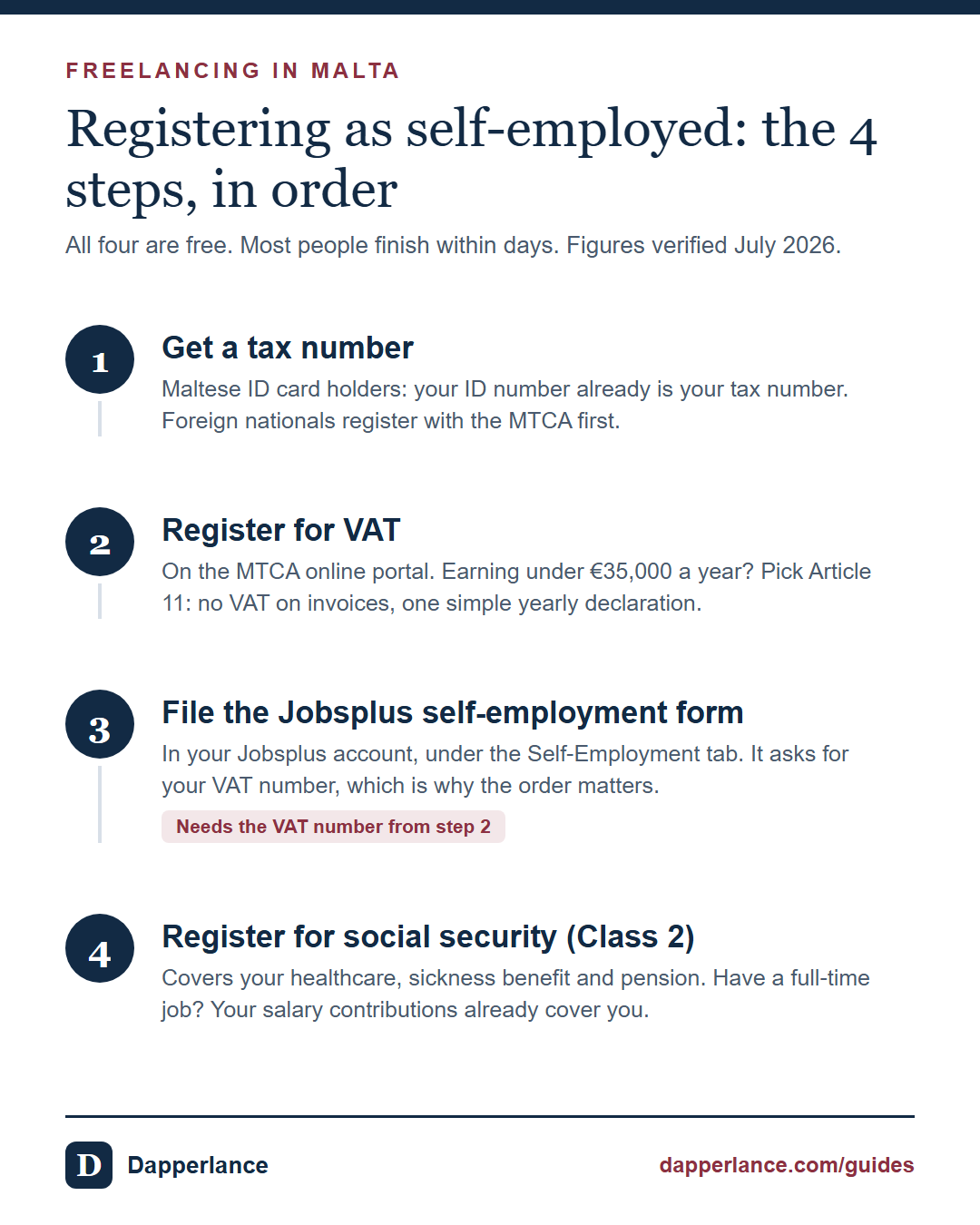
What do I need to register? The 4 steps in order
Four free registrations. Do them in this order, because step 3 asks for your VAT number from step 2.
- Tax number. If you have a Maltese ID card, your ID number already is your tax number. Foreign nationals without one first register with the Malta Tax and Customs Administration (MTCA) for a taxpayer reference.
- VAT number, on the MTCA online portal. You register even if you will earn under the exemption limit. What changes is which article you pick (next section).
- Jobsplus self-employment form. Log into your Jobsplus account, open the Self-Employment tab, fill in the form (it asks for your VAT number), submit (official Jobsplus instructions). No account or no internet: email the form to [email protected] or hand it in at their head office. One form per occupation if you have several (say, photographer and consultant).
- Social security (Class 2). This puts you in the pension, sickness and healthcare system. Payments run through the MTCA.
There is no company to form, no notary, no minimum money required. Most people finish the whole chain within days.
Why won’t the VAT registration form submit?
The usual cause is a letter outside the basic English alphabet in your name or address. The online VAT application fails silently on characters like Ħ, ä, ö and ż. Nothing tells you it failed: the page scrolls back to the top, the ID document you attached is cleared, and no reference number appears.
Retype them as plain letters and submit again:
| Type this | Instead of |
|---|---|
| H, h | Ħ, ħ |
| Z, C, G | Ż, Ċ, Ġ |
| A, O | Ä, Ö, Å |
| E, U | É, Ü |
So a locality written Ħaż-Żebbuġ goes in as HAZ-ZEBBUG, and Ħamrun goes in as HAMRUN.
Your own MTCA tax registration certificate is the guide to follow: whatever spelling the tax office already holds for your name and address is the spelling their system accepts. Foreign names are normally stored there without accents, so a surname written “Müller” appears as “Muller”.
Two other things on this form catch out non-Maltese applicants:
- No Maltese ID card? Enter NA in the I.D. Card No field, in the applicant section and again in the declaration at the bottom. You are identified by your IR Tax No and the passport copy you upload.
- The uploaded ID document is cleared every time the form reloads. Attach it again before each retry. The size limit is 5MB.
Do I have to charge VAT? (The Article 11 exemption)
No, as long as your yearly turnover stays under €35,000 and you register under Article 11. When you register for VAT you choose between:
- Article 10 (standard): you add 18% VAT to your invoices, file VAT returns during the year, and can claim back VAT on business purchases.
- Article 11 (small / exempt): for turnover under €35,000 a year (one single limit since 2025, replacing the old separate goods/services limits – see the MTCA Article 11 guidelines). You charge no VAT and file one simple yearly declaration, but you cannot claim back VAT on what you buy.
Most new freelancers pick Article 11 and switch to Article 10 if they grow past the limit or their business clients want full VAT invoices.
Mistake to avoid: passing €35,000 without switching. You then owe VAT you never charged, out of your own pocket.
How much tax do I pay as a freelancer in Malta?
Nothing on your first €12,000 of profit per year. After that, normal progressive rates. You are taxed on profit (income minus business expenses), not on everything you invoice. The 2026 rates, single computation (official MTCA 2026 rates):
| Profit | Rate |
|---|---|
| €0 – €12,000 | 0% |
| €12,001 – €16,000 | 15% |
| €16,001 – €60,000 | 25% |
| over €60,000 | 35% |
Married and parent rates have wider 0% bands. These bands were widened in 2025, so ignore older guides that say tax starts at €9,100.
Two things that catch people out:
- Provisional tax: once established, you pay tax in three instalments during the year (April, August, December), based on last year’s profit, settled with the June 30 tax return.
- Keep every receipt from day one. Expenses reduce your taxable profit, but only if you can prove them.
What if I have a job and freelance on the side?
You can pay a flat 10% on your side profit, up to €12,000 a year, kept completely separate from your salary. This is a yearly cycle: each year, you add up that year’s side profit, file form TA22, and pay the 10% by 30 April of the following year (official MTCA page). Example: side profit earned during 2026 is declared on a TA22 and paid by 30 April 2027. Profit above €12,000 in a given year is taxed at the normal rates.
Mistake to avoid: the 10% rate is not automatic. Miss the TA22 form or the deadline and the profit joins your normal income, taxed at 25% for most employed people.
How much is social security (Class 2)?
It depends on whether freelancing is your main work or a side activity:
- You also have a full-time job: nothing extra. You pay social security only through your employment (Class 1, deducted from your salary). Your side freelancing does not add a second contribution (official rules).
- Freelancing is your main work: you pay Class 2 contributions, a fixed weekly rate, three times a year (April, August, December, together with provisional tax). The rate is 15% of the net income you declared the previous year, within a minimum and maximum published yearly in the official MTCA Class 2 table: roughly €32 to €84 per week in 2026, so €1,700-4,400 per year.
- No Malta income history? If you just registered, or just moved to Malta (there is no “last year in Sweden” carried over), your rate is based on the income you expect and declare when you register. Low or uncertain starting income usually means the minimum rate, and the rate adjusts in later years as your declared income comes in.
- Below the minimum is possible in specific cases: very small self-employed income (under roughly €910 a year) carries no contribution duty, and students under 25, pensioners and part-time self-occupied women can apply to the MTCA for a reduced pro-rata 15% rate with no weekly minimum.
For full-time freelancers it is not optional: it is what entitles you to healthcare, sickness benefit and a pension.
Should I register as self-employed or set up a company?
Compare the running costs against your expected profit. Rough numbers below.
Registering self-employed costs nothing and needs no accountant. A limited company (Ltd) in Malta typically costs €1,500-3,000 every year to run: accounting, the mandatory annual audit (Malta requires audits even for small companies), and the annual return. It also needs €1,165 minimum share capital (only 20% must be paid up). What you get for that money: limited liability (the company’s debts are not your personal debts) and, at higher profits, corporate tax structuring that can beat personal rates.
Rough guide (estimates, not advice):
- Profit under ~€40,000/year: self-employed is almost always cheaper. The company’s yearly running costs eat any tax advantage.
- Profit consistently above ~€60,000/year: worth paying an accountant once to compare, because at that level corporate structuring can save more than the company costs to run.
- At any profit level, a company earns its cost if your work could make you liable for more than you own (you could be sued over a big project), a client or industry requires contracting with a company, or you plan to take on partners or investors.
You can also start self-employed and incorporate later. Many do.
I’m not Maltese: what extra steps apply?
- EU/EEA/Swiss citizens: you have the right to be self-employed in Malta. You do the same four steps, plus an eResidence document from Identità if you stay longer than 90 days.
- Non-EU citizens: you need residence status that allows self-employment before anything else. The self-employed single permit has significant requirements (investment and a business plan). The Nomad Residence Permit covers remote workers with foreign clients but does not allow working for the Maltese market. The short version: secure residence status first, registrations second.
How do I get my first clients in Malta?
List your service where buyers already look, and tell your network. Malta’s market is small and runs on word of mouth, which helps when starting: visibility spreads fast.
- Post a listing on Dapperlance, Malta’s freelance marketplace: free, no commission, enquiries come through chat.
- Facebook groups are where much of Malta’s hiring actually happens. Answer requests in the relevant local groups.
- Tell people you are open for work. One referral chain reaches most industries on this island.
- Price deliberately. Check what established competitors charge first. Underpricing reads as inexperience here, not as a bargain.
Frequently asked questions
How long does registration take?
Each step is usually processed within days. Allow one to two weeks for the full chain.
Does registering cost anything?
No, all four registrations are free. Your first real costs are social security contributions and, if you want one, an accountant (roughly €300-600/year for a simple setup).
Can I freelance alongside a salary without telling anyone?
No. All paid work must be declared to Jobsplus and in your tax return. The 10% part-time rate exists precisely to make declaring side income cheap.
Do I need an accountant?
Not legally, for a simple Article 11 setup. Many people file themselves in year one. Get one when you approach the VAT limit, hire someone, or your expenses get complicated.
Can I deregister if it doesn’t work out?
Yes: tell Jobsplus you have stopped, file a final VAT declaration, deregister the VAT number, and settle outstanding contributions. No exit fees.
Reminder: this is a summary, last verified July 2026. Before you register or file anything, confirm the current figures and procedures on the official pages linked throughout this guide.
More practical guides for freelancing and hiring in Malta: dapperlance.com/guides.
Put this guide to work
Dapperlance is Malta's free freelance marketplace: no commission, direct chat between you and the other side.
Post your listing freeBrowse freelancers